
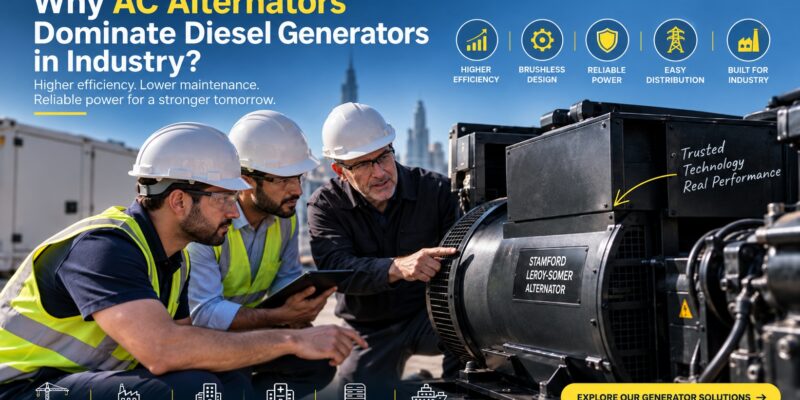
Pop the hood on any industrial genset and you’ll find two machines doing two very different jobs. The diesel engine burns fuel and turns a shaft. The alternator takes that spinning shaft and turns it into electricity a facility can actually use.
The overwhelming majority of that electricity, for commercial and industrial gensets, comes out as alternating current, not direct current. That’s not tradition for its own sake — it’s because AC lines up with how buildings, factories, and job sites are wired. Three-phase AC feeds motors efficiently, transformers can step voltage up or down cheaply, and today’s brushless synchronous alternators run for long stretches without the upkeep that older brush-type machines demanded.
That combination is why AC alternators show up on standby power for hospitals and data halls, prime power on construction sites, and everything in between.
At Arrowad International Trading, that alternator lineup is built around Leroy Somer and Stamford machines, paired into custom diesel generator sets using Cummins or Perkins engines.
Picking the right one, though, is never as simple as lining up two kVA numbers. Frequency, voltage, excitation type, motor inrush, power factor, harmonics, and site conditions all pull in different directions. This guide walks through why AC won out as the standard, and what actually needs checking before you commit to a machine.
The Short Version
Diesel gensets generate AC because the equipment sitting downstream — motors, transformers, switchgear — is built to run on it. A well-specified synchronous AC alternator gives you:
- single-phase or three-phase output
- steady operation at 50 Hz or 60 Hz
- voltage held in check by an AVR
- straightforward compatibility with standard industrial motors
- brushless excitation on most modern designs
- solid efficiency across a wide span of ratings
- reasonable transient response, provided it’s sized for the load
Anything downstream that actually needs DC — battery charging, control electronics, a DC bus — gets it from rectifiers and converters fed off that AC output. The generator itself doesn’t need to produce DC directly.
Inside an AC Alternator: What’s Actually Happening
Strip a genset down to its two core machines. The engine turns fuel into rotation. The alternator turns that rotation into electricity.
Inside a typical synchronous alternator, the engine spins a rotor, and that rotor carries a magnetic field around with it. As the field sweeps past the stationary stator windings, it induces alternating voltage in them. No physical contact between the moving field and the output — just electromagnetic induction doing the work.
Simplified, the chain looks like this:
From there, a set of supporting components shapes and protects that output:
- Automatic Voltage Regulator (AVR)
- exciter and rotating rectifiers
- Permanent Magnet Generator (PMG), on some models
- breakers and protection relays
- generator controller
- switchgear
None of these are afterthoughts. The alternator’s design choices ripple into how stable your voltage is under load, how it handles a big motor starting, how it behaves during a fault, and what kind of equipment it can realistically support.
AC Alternator vs. Traditional DC Generator
| Feature | AC Alternator (industrial) | DC Generator (traditional) |
|---|---|---|
| Output type | Alternating current | Direct current |
| Typical industrial output | Three-phase | DC |
| Prevalence today | Standard | Niche applications |
| Changing voltage | Simple, via transformer | Usually needs power electronics |
| Driving AC motors | Direct connection | Needs an inverter |
| Commutator | Not needed in standard synchronous design | Required |
| Brushless design | Common | Different architecture entirely |
| Voltage regulation | AVR + excitation system | Depends on design |
| 50/60 Hz distribution | Native | Requires conversion |
| Large genset use | The norm | Rare |
DC hasn’t gone anywhere, of course — batteries, telecom gear, and control loops all depend on it. The point is narrower: the grid a genset feeds into is built for AC, so generating AC at the source is the path of least resistance.
The Case for AC, Point by Point
1. Because the Loads Downstream Expect It
Look at what’s actually plugged into an industrial genset: induction motors, pumps, compressors, chillers, conveyors, cranes, elevators, VFDs, lighting, transformers, motor control centres. All of it is AC-native.
Feed that from an AC alternator and you skip a layer of conversion hardware entirely. You could in theory drive it all from a DC source through a large inverter bank, but for a standard prime or standby installation, that’s solving a problem you didn’t need to create.
2. Three-Phase Suits Industrial Loads
Small residential units might get away with single-phase, but commercial and industrial sites lean on three-phase almost universally — it moves more power through smaller conductors and pairs naturally with rotating machinery.
For a balanced three-phase system, real power works out roughly to:
That relationship between kW and kVA is also why generator spec sheets show both figures. kW is the useful work; kVA is the apparent power draw; power factor bridges the two. Sizing off kW alone, on a motor-heavy site, is a common way to under-spec a genset.
3. Voltage Steps Up and Down Cheaply
Transformers make AC voltage easy to reshape. Push voltage up for a given power level and current drops — which matters because cable losses scale with the square of current:
That’s relevant the moment power has to travel any distance across a site — a large facility, a temporary construction feed, a spread-out distribution network. The alternator doesn’t need to produce the final delivery voltage itself; transformers handle that step wherever the layout calls for it.
DC-side voltage conversion exists too — HVDC transmission is a real and growing field — but for a conventional diesel genset bolted onto standard switchgear, AC is still the path that plugs into existing infrastructure without extra engineering.
4. Brushless Excitation Cuts Down Maintenance
Worth separating two things that get conflated: producing AC doesn’t automatically mean a machine is brushless. They’re independent design choices. That said, most industrial synchronous alternators paired with diesel gensets today do use brushless excitation.
Older brush-type machines pass field current through physical brushes and slip rings — points of contact that wear over time. A brushless design routes around that for the main field circuit:
Because the rectifiers spin with the rotor, DC excitation reaches the main field without a brush-and-slip-ring path.
Practically, that translates to less brush-related servicing, no carbon dust from the main excitation circuit, fewer wear parts, and dependable long-run operation. It’s not a free pass on maintenance overall — bearings, windings, insulation, cooling, and the rectifier assembly itself still need regular attention.
5. The AVR Absorbs Load Swings
Loads don’t sit still. A site running at moderate draw can suddenly throw a large pump or compressor online, and the alternator has to absorb that without its voltage sliding outside acceptable bounds.
That’s the AVR’s job — watching output and adjusting excitation on the fly:
This matters more on some sites than others — motor-heavy plants, HVAC systems, UPS-backed loads, telecom and automation gear all lean on tight AVR response. It’s a spec worth reviewing on its own terms, not something to assume comes standard across every alternator model.
6. PMG Excitation for Harder Loads
Some alternators add a Permanent Magnet Generator (PMG) — a small, self-contained generator that feeds the AVR independently, rather than drawing its own power from the main stator output.
Why bother? When a large load hits suddenly, main output voltage can sag. An excitation system with its own independent power source keeps supplying the AVR through that dip, rather than losing steam right when it’s needed most.
PMG tends to earn its cost where you’ve got large motor starts, fast load swings, nonlinear loads, or tight fault-current requirements. For a stable, predictable commercial load, a simpler self-excited system is often plenty — the load profile should be what decides it, not a blanket assumption either way.
7. Direct Compatibility With Industrial Motors
Motors are everywhere in industrial power — pumps, compressors, fans, conveyors. Most of that gear runs on rugged, inexpensive three-phase squirrel-cage induction motors, and an AC alternator can feed them straight off the site’s normal distribution, no conversion hardware needed.
The catch: starting current dwarfs running current. A generator that handles a motor comfortably once it’s up to speed can still stumble badly the moment that same motor tries to start.
8. Motor Starting Often Drives the Whole Sizing Decision
Take a large pump motor as an example. Once spinning, it might draw a perfectly reasonable current. But direct-on-line starting can pull several times that figure for a few seconds — enough to cause:
- a voltage dip
- frequency wobble
- contactors dropping out
- controller faults
- a motor that struggles to reach speed
- knock-on trouble for other connected equipment
“Buy a bigger generator” isn’t automatically the fix. Engine capacity, alternator sizing, excitation type, starting method, and how much voltage dip is actually tolerable all factor in together. Depending on the site, the better answer might be a stronger-starting alternator, PMG excitation, deliberate alternator oversizing relative to the engine, star-delta starting, a soft starter, a VFD, or simply staggering large loads instead of hitting them all at once.
This is the argument for sizing off a real load schedule — not just adding up nameplate figures.
9. Scales Cleanly Across Ratings
A telecom cabinet and a manufacturing plant might both need diesel backup, but their power, voltage, and duty requirements have nothing in common. Synchronous alternator design scales across that range without reinventing itself each time — Arrowad’s Leroy Somer and Stamford lines cover roughly 9 to 3,000 kVA, which lets sizing start from the actual site requirement rather than forcing every project into the same box.
Getting the rating right still comes down to more than a headline kVA figure — engine output, ambient conditions, frequency, voltage, duty class, and the load’s own character all play in.
How Gensets Hold 50 Hz or 60 Hz
Electrical frequency ties directly to rotor speed and pole count:
- f = frequency (Hz)
- P = number of poles
- N = rotor speed (RPM)
| Frequency | Synchronous Speed |
|---|---|
| 50 Hz | 1,500 RPM |
| 60 Hz | 1,800 RPM |
The engine governor holds speed steady; the alternator converts that speed into the matching electrical frequency. It’s why a machine built for a 50 Hz market can’t be treated as a drop-in for a 60 Hz one — engine speed, alternator rating, voltage tapping, and downstream equipment compatibility all need checking against the destination.
Choosing Between 50 Hz and 60 Hz
This one’s dictated almost entirely by where the generator will operate — different countries standardise on different frequencies, and the genset has to match local grid frequency, required voltage, connected motor ratings, and site switchgear.
Arrowad stocks both 50 Hz and 60 Hz configurations across its Leroy Somer range, with separate prime and standby ratings for each. Always size off the rating published for the specific operating frequency — don’t assume a machine performs identically at both.
Self-Excited vs. PMG: Which Excitation System
| Feature | Self-Excited | PMG-Excited |
|---|---|---|
| AVR power source | Main stator output | Independent PMG |
| Complexity | Lower | Higher |
| Standard commercial loads | Usually fine | Also fine |
| Heavy motor starting | Depends on design | Generally stronger |
| Sudden load swings | Case-by-case | Typically better suited |
| Nonlinear loads | Needs checking | Often the safer default |
| Relative cost | Lower | Higher |
Neither is universally “correct.” Paying for PMG on a load that never needed it is wasted budget; skimping on excitation for a genuinely demanding motor-starting or nonlinear-load site is a different kind of expensive mistake.
Harmonics and Nonlinear Loads
Not every load pulls a clean sine wave. VFDs, UPS units, battery chargers, rectifiers, and data equipment all introduce harmonic distortion into the system, and alternator winding design, reactance, and excitation strength all affect how gracefully a machine absorbs that.
If a project has a heavy share of nonlinear equipment, flag it to the supplier before sizing — a machine picked on kW alone might not deliver the waveform quality or transient recovery the site actually needs. For critical applications, it’s worth reviewing THD, voltage regulation, transient dip and recovery, subtransient reactance, short-circuit capability, and neutral current handling specifically.
A Practical Checklist Before You Specify an Alternator
- Required kVA and kW — build this from an actual load schedule, running loads separated from starting loads, not a rough estimate.
- Power factor — industrial kVA ratings assume a stated PF; confirm both apparent and real power needs.
- Frequency — 50 Hz or 60 Hz, matched to the engine and destination grid.
- Output voltage — direct connection, or via transformers?
- Phase configuration — single-phase for smaller loads, three-phase for most commercial and industrial sites.
- Duty class — prime vs. standby ratings aren’t interchangeable; use the manufacturer’s rating for the actual duty cycle.
- Largest motor on site — kW, starting method, starting current, load torque, tolerable voltage dip. This one item alone can reshape the whole spec.
- Load steps — how much can come online in a single jump versus in stages.
- AVR and excitation type — self-excited, auxiliary, or PMG, matched to the load profile.
- Harmonic-generating equipment — UPS, VFDs, rectifiers, flagged before sizing, not after.
- Ambient temperature — outdoor heat versus a conditioned enclosure changes the picture.
- Altitude — thinner air affects cooling; check manufacturer derating for high-altitude sites.
- Enclosure and environment — IP rating, humidity, dust, salt exposure, ventilation.
- Insulation class and temperature rise — pulled from manufacturer documentation against project requirements.
- Room for growth — plan some headroom if expansion is realistic, but don’t overshoot; a diesel engine idling for long stretches at very low load creates its own set of problems.
Standards Worth Knowing
Generator selection at a professional level also sits against ISO 8528, the standards family covering reciprocating-engine-driven generating sets:
- ISO 8528-1 — application, ratings, and performance classification
- ISO 8528-3:2020 — AC generator and excitation-control characteristics
- ISO 8528-5:2025 — combined engine-and-alternator design and performance
- ISO 8528-13:2026 — safety requirements
Depending on the project, local IEC rules, hospital or high-rise codes, hazardous-location requirements, or utility paralleling standards may layer on top. A standard referenced on a spec sheet is only useful if the actual machine has been checked against it for the specific project and destination market.
Leroy Somer and Stamford at Arrowad
Arrowad’s alternator range runs on Leroy Somer and Stamford machines across roughly 9–3,000 kVA, in both 50 Hz and 60 Hz, prime and standby configurations.
These pair into custom diesel generator sets with Cummins or Perkins engines, alongside Yuchai G-drive engines, genuine spare parts, controllers, batteries, steel work, and broader generator accessories.
Start from the site, not the brand. Power requirement, starting loads, voltage, frequency, duty cycle, ambient conditions, and transient performance needs come first — the engine and alternator get matched around those.
Where DC Still Belongs
None of this makes DC obsolete. It’s essential for starting batteries, control circuits, telecom gear, battery storage, electronics, and specialised DC motor applications. Most facilities run both simultaneously — the genset supplies AC to the site’s main distribution, and rectifiers, chargers, or UPS units convert whatever portion actually needs to be DC.
It’s less “AC beats DC” and more that each part of a power system tends to want a different form of electricity. For the generation step itself, on a conventional diesel genset, AC remains the practical default.
Bottom Line
AC alternators became standard on industrial diesel gensets because they match the infrastructure already in place — three-phase distribution, motors, transformers, switchgear. Modern synchronous designs layer in brushless excitation, AVR regulation, and optional PMG excitation to cover everything from routine standby duty to heavy motor-starting and harmonic-heavy environments.
What it shouldn’t come down to is a single kVA figure. A properly specified genset accounts for the whole system — engine, alternator, excitation, controls, connected loads, environment, and duty cycle — because that’s what determines whether it actually performs when called on, not just whether the nameplate looks big enough.
Arrowad International Trading supplies Leroy Somer and Stamford alternators, custom diesel generator sets, Yuchai G-drive engines, genuine spare parts, and generator accessories from its Jebel Ali Free Zone facility in Dubai.
Need the Right Alternator or Diesel Generator?
For a quotation, share your required kVA/kW, voltage, frequency, phase, application, and largest starting load — that’s the fastest route to an accurate recommendation.