
Generator Sizing & Power Guides
If you’ve spent any time requesting generator quotes, you’ve probably noticed something odd: every supplier talks in kVA, but every client thinks in kW. That mismatch is where most sizing mistakes start — and it’s usually the client who pays for it later, in the form of tripped breakers, overheating, or a generator that’s twice the size (and cost) it needed to be.
This guide breaks kVA down properly — not the one-paragraph version you’ll find on most supplier websites, but the version that actually helps you buy the right machine.
The Short Answer
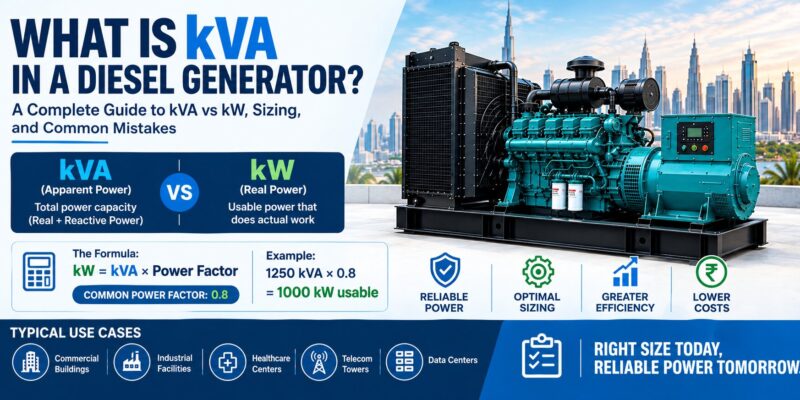
kVA (kilovolt-ampere) measures a generator’s total apparent power output — its full electrical capacity. It’s different from kW (kilowatt), which is the real, usable power your equipment draws. Generators are rated in kVA because they have to supply both real power and reactive power at once, and kVA is the only number that captures the whole picture.
If you only remember one thing from this page, make it that formula.
Why Manufacturers Rate Generators in kVA, Not kW
This trips people up because in everyday life, we talk about power in kW — your electricity bill, your air conditioner’s spec, your car charger. So why do generators break from that convention?
Because a generator doesn’t just power resistive loads like heaters and light bulbs. It also has to power inductive loads — motors, compressors, pumps, transformers — and those need extra electrical “push” just to build and maintain their magnetic fields, on top of the actual work they do. That extra push is reactive power (kVAR), and it doesn’t show up as useful output, but the generator still has to generate it.
kVA is the sum of both: kVA² = kW² + kVAR²
Rating a deisel generator in kW alone would hide half the story — the machine would look capable of running more than it actually can once real-world motors and compressors are switched on.
kVA vs kW: A Side-by-Side Comparison
The conversion:
kW = kVA × Power Factor
kVA = kW ÷ Power Factor
Worked example: A supplier quotes a 1250 kVA unit at a 0.8 power factor.
1250 × 0.8 = 1000 kW usable
That 1000 kW is the figure you should be comparing against your building’s actual electrical demand — not the 1250.
What Actually Happens When You Get Sizing Wrong
Most articles list this as a bullet point. It’s worth explaining why each one happens, because that’s what actually helps you avoid it.
If the generator is undersized
- Tripping on startup — when multiple motors (AC compressors, pumps, lifts) start simultaneously, their combined inrush current can spike well past the generator’s capacity, and the protection relay cuts power to prevent damage.
- Voltage sag — under heavy load, output voltage drops below the safe range, which can shorten the life of — or outright damage — sensitive electronics, control panels, and IT equipment.
- Accelerated wear — an engine constantly running near or above its rated limit runs hotter and wears out faster than one operating in its efficient range.
If the generator is oversized
- Wet stacking — running well below the generator’s rated capacity for long periods means the engine doesn’t reach optimal combustion temperature, leaving unburned fuel residue in the exhaust system, which causes long-term engine damage.
- Wasted capital — a bigger unit costs more upfront, consumes more fuel at idle/low-load operation, and takes up more space than the project needed.
The goal isn’t “bigger is safer.” It’s accurate.
How to Size a Generator the Right Way
- List every load that will run simultaneously. HVAC, pumps, lighting, elevators, machinery, server racks — anything drawing power at the same time counts toward your peak demand, not your total inventory of equipment.
- Identify your highest-surge equipment. Motors and compressors can draw 3–7× their running load for a few seconds on startup. This is usually the number that decides your minimum generator size — not the steady-state total.
- Convert your load to kVA. Take your total kW requirement and divide by your power factor (typically 0.8) to get the kVA your generator needs to supply.
- Choose the correct duty rating. Standby (occasional backup, limited annual hours), prime (variable load, unlimited hours), and continuous (constant full load) generators are engineered differently — using the wrong duty type shortens the machine’s service life regardless of how correctly it’s sized in kVA.
- Add a growth margin. 15–25% headroom above your calculated peak load is standard, so a new piece of equipment next year doesn’t push you back into undersized territory.
- Verify with a load study, not a guess. For anything above a small commercial application, a proper load assessment — ideally done on-site — catches gaps that spreadsheet math alone misses.
Common kVA Ratings and What They’re Typically Used For
Why kVA Sizing Is a Bigger Deal in the UAE Than It Looks
Extreme heat changes how a generator performs — engines run hotter, cooling systems work harder, and derating (a generator’s real-world output being lower than its rated output under harsh ambient conditions) is a factor a lot of first-time buyers don’t account for. On top of that, sectors like data centers, hospitals, oil & gas, and telecom infrastructure operate around the clock, where even a short power interruption isn’t just inconvenient — it’s a safety and financial risk.
That combination — heat-related derating plus zero tolerance for downtime — is exactly why sizing needs to be done properly here, not estimated from a generic chart built for a temperate climate.
A Quick Myth Check
Not true — oversized units run inefficiently at low load and can develop engine problems faster than a correctly sized one.
It’s a common industry assumption, not a universal constant. Loads heavy in electronics or lighting may run at a higher power factor; heavy motor loads may run lower.
They measure genuinely different things — one is total capacity, the other is usable output. Treating them as interchangeable is the single most common sizing error we see.
Frequently Asked Questions
Is kVA the same as kW?
No. kVA is total apparent power (what the generator is capable of supplying); kW is real, usable power (what your equipment actually consumes).
Why are diesel generators rated in kVA instead of kW?
Because they must supply both real power and reactive power to run inductive loads like motors and compressors — kVA is the only figure that accounts for both.
What power factor should I use to convert kVA to kW?
0.8 is the standard industry assumption for most three-phase diesel generators, though your actual equipment mix may sit higher or lower.
How do I calculate the generator size I need?
Total your simultaneous running load, add margin for motor startup surges, convert to kVA using your power factor, select the correct duty type, and build in 15–25% headroom for future growth.
What happens if I install an undersized generator?
It will trip under peak demand, run hot, and cause voltage instability that can damage connected equipment over time — and shorten the generator’s own lifespan.
Does UAE heat affect generator sizing?
Yes. High ambient temperatures can reduce a generator’s real-world output below its rated capacity, which needs to be factored into sizing for outdoor or poorly ventilated installations.
Get the Sizing Right the First Time — Talk to Arrow Ad Trading
A correctly sized generator isn’t just a technical box to tick — it’s the difference between a power system that runs quietly for a decade and one that becomes a recurring cost. Arrow Ad Trading works with businesses across the UAE to calculate real load requirements, account for local operating conditions, and recommend generators built for the job — not just the biggest number on a price list.
Related reading
- Explore Arrow Ad Trading’s full generator range — browse standby, prime, and continuous-duty diesel generators sized for UAE conditions.
- Request a free load assessment from Arrow Ad Trading — get an on-site calculation before you commit to a kVA rating.